
The Hauber Method Is Back-Pain Treatment that Works
Sara Hauber has been a functional-movement specialist for more than two decades. Motivated by her own experience with severe scoliosis and spinal fusion, she got educated, relieved her pain, and never looked back.
Over the years, clients have come to Hauber because their other solutions for back pain have not worked.
They’ve tried pain pills, steroid shots, physical therapy, and even surgery for back pain treatment . . . and it either hasn't worked, or relief was very short term.
Hands down, they were all simply tired of the daily struggle with pain and the reactions of friends and family who just didn’t understand what they were going through.
The Hauber Method has been their lasting solution to long-term back and joint pain.
The Hauber Method taught them how to understand and relieve their pain without drugs or surgery, and opened the door for them to have a fantastic relationship with their own body.
Over the years, clients have come to Hauber because their other solutions for back pain have not worked.
They’ve tried pain pills, steroid shots, physical therapy, and even surgery for back pain treatment . . . and it either hasn't worked, or relief was very short term.
Hands down, they were all simply tired of the daily struggle with pain and the reactions of friends and family who just didn’t understand what they were going through.
The Hauber Method has been their lasting solution to long-term back and joint pain.
The Hauber Method taught them how to understand and relieve their pain without drugs or surgery, and opened the door for them to have a fantastic relationship with their own body.
Based on functional strength and movement science, The Hauber Method also incorporates some of the most effective, appropriate, and non-injurious aspects of yoga (mindfulness, breathing) and physical therapy (myofascial release).
When practiced as taught, the exercises and stretches included in Hauber Method program are proven to strengthen your core, support your spine, and empower you with knowledge so you can move, sit, and stand without back pain.
When practiced as taught, the exercises and stretches included in Hauber Method program are proven to strengthen your core, support your spine, and empower you with knowledge so you can move, sit, and stand without back pain.
I came to Sara's workshop with a nagging pain, and left without it! What more needs to be said?
--Diane N.
The Hauber Method™ has eliminated my lower back problems completely! I believe that because you start from first principles and build up from there, you also give us the tools to understand, evaluate, and correct any future problems we may have. During my 60 years on this planet, I have tried many types of bodywork, yoga, etc., to stop my pain, and I love them all, but The Hauber Method™ is the ONLY thing that has given me lasting relief. --Karen F.
Sara Hauber is an excellent teacher, explaining the mechanics of the human body and movement with great examples and demonstrations, individualized attention, and so much expertise. And she makes it all fun while being super approachable and concerned about each student. --Laura O.
If yoga instructors would take her courses as part of their training we would have fewer hip and back injuries. --Joy M.
I have taken several of Sara's workshops and come away from each one with useful information and techniques I can use that help improve the way I feel. Knowledge is power, so it feels good to learn things that encourage a friendlier relationship with my own joints. --Kathy W.
--Diane N.
The Hauber Method™ has eliminated my lower back problems completely! I believe that because you start from first principles and build up from there, you also give us the tools to understand, evaluate, and correct any future problems we may have. During my 60 years on this planet, I have tried many types of bodywork, yoga, etc., to stop my pain, and I love them all, but The Hauber Method™ is the ONLY thing that has given me lasting relief. --Karen F.
Sara Hauber is an excellent teacher, explaining the mechanics of the human body and movement with great examples and demonstrations, individualized attention, and so much expertise. And she makes it all fun while being super approachable and concerned about each student. --Laura O.
If yoga instructors would take her courses as part of their training we would have fewer hip and back injuries. --Joy M.
I have taken several of Sara's workshops and come away from each one with useful information and techniques I can use that help improve the way I feel. Knowledge is power, so it feels good to learn things that encourage a friendlier relationship with my own joints. --Kathy W.
The Hauber Method™ relaunched in 2019
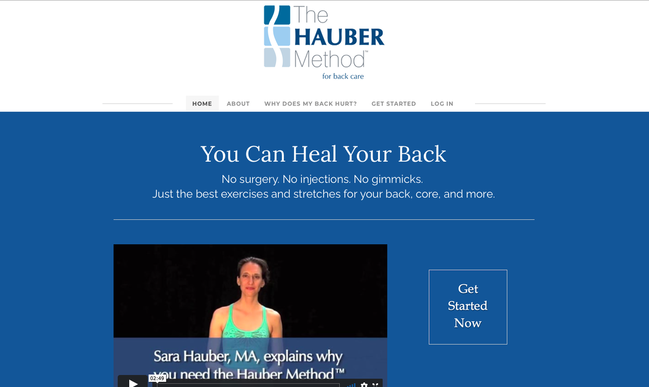
Click the image to visit HauberMethod.com!
The video-only version of the Hauber Method™ program was discontinued in 2015 due to the many challenges of keeping a complex website running smoothly. It was a tough decision, because the program works.
Hauber now only offers one-on-one consultations to adults seeking lasting relief from back pain.
Hauber now only offers one-on-one consultations to adults seeking lasting relief from back pain.